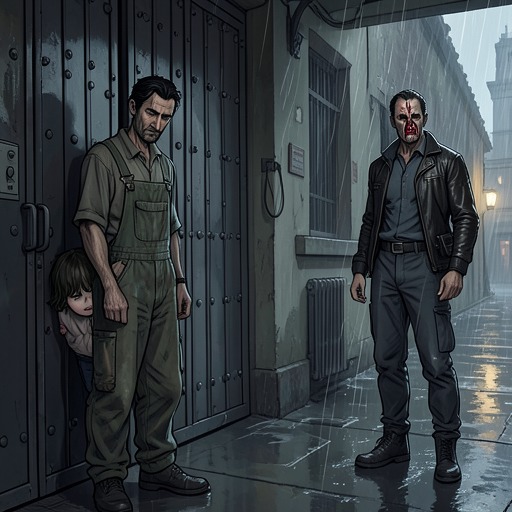
Elena Djourescu
Impure BloodElena Djourescu is a young mother whose family history is bound to the wartime betrayal of Adam Djourescu and the concealed origins of Jean Florian. The novel first presents her through recollection as lively and self-possessed; later disclosures make her newborn son’s fate the hinge between two families and expose how a private act of deception becomes an inherited wound.
Identity and Background
Madame Laseige recalls Elena as one of two women in their apartment block who were pregnant in the same summer. Elena already had a daughter, Olivie, and was described as spirited and earthy. Though she had not been especially close to Louise Florian before their pregnancies, the two women grew somewhat closer as their expected deliveries approached. Madame Laseige qualifies that connection: they were not confidantes, but the shared circumstances of pregnancy brought them into a degree of companionship.
Elena’s temperament is set against Louise’s quieter, plainer manner. The contrast comes from Madame Laseige’s retrospective perspective rather than Elena’s own voice; the narrative gives Elena no direct account of her desires or experience. Her characterization nevertheless establishes her as a distinct presence within the block, not merely a name attached to the later mystery.
The Births and the Switch
Madame Laseige, then a young mother, helped when Louise gave birth. Louise’s pregnancy had not been difficult, but something went wrong near its end, and her baby arrived early and was stillborn. A few hours later, Elena gave birth to a healthy boy. Madame Laseige was not present at Elena’s delivery, a limitation she makes clear as she recounts the sequence.
The timing matters because an earlier report, read by Yvonne Flaco, had reversed the births and deaths, claiming that Elena’s premature baby had died. The correction comes not as an abstract amendment but through Madame Laseige’s account of what she witnessed around the two households. It establishes that Louise’s child was stillborn and that Elena’s son was alive.
When soldiers entered the building, Adam Djourescu first ran toward Louise and Marcel’s apartment carrying his newborn son. He then hurried back toward his own apartment, still carrying a bundle. Madame Laseige remembers that the second bundle was no longer moving. Her account implies that the living boy had been exchanged for the stillborn child as the soldiers approached, though the precise act is conveyed through the movement between the apartments and the changed condition of the bundle rather than through a full description.
Family, Betrayal, and Hidden Identity
A later revelation identifies Elena as Adam Djourescu’s wife and describes her as his pride and joy. Jean Florian learns from a letter written by Emil Florian that Jean was a Jewish baby given away at birth. Emil’s account names Adam and Elena as the couple betrayed by a fellow officer and sent to Auschwitz; the informant’s forename is given as Vincent. Jean passes the revelation to his son David, believing that David should know what happened to his true grandparents and that the truth explains his own exclusion within the Florian family.
The novel also presents a competing, retaliatory account. During Agnès Dantier and Vincent Dantier’s captivity, David Jarret claims that Adam had tried to pursue Elena and that she laughed at him. Agnès rejects the story as implausible and challenges David’s reliance on what she calls a decades-old lie. The accusation therefore appears within a scene of coercion and dispute, not as an independently confirmed account of Elena’s conduct. Set beside the account of Adam and Elena’s betrayal, it shows how the past has been reshaped into a justification for David’s present actions.
Narrative Significance
Elena never appears in the supplied scenes as an active participant in the present-day investigation. Her significance emerges through other people’s testimony, a corrected report, and the consequences of a concealed birth. The contrast between the living child and the stillborn one gives the family secret its material basis; the later discovery of that secret links the wartime persecution of a Jewish family to Jean’s damaged place among the Florians and to David’s attempt to reclaim a relationship with his father.
The accounts also make Elena’s memory contested. Madame Laseige’s account provides the birth sequence and the bundle’s reversal, while Emil’s letter transmits the history of betrayal and David’s accusation recasts Elena as the object of a grievance. The novel thus gives her importance without granting her a speaking role: her identity and the fate of her child are narrated by others, and the truth about the past remains entangled with the motives of those who invoke it.